
Key Intake
Q1: What do music industry attorneys do?
They protect your creative and financial rights by negotiating fair deals, registering copyrights, and ensuring you get paid for your music.
Q2: How much do music lawyers charge artists?
Costs ranges anywhere from $250–$900 per hour depending on the firm’s size and the deal’s complexity, but flat-fee options exist for smaller projects.
Q3: Why do independent musicians need attorneys?
Because every contract affects your rights, royalties, and ownership a lawyer ensures you don’t sign away long-term control.
Q4: Which music law firms specialize in record deals?
Top names include Ziffren Brittenham, Greenberg Traurig, and Alter, Kendrick & Baron, known for handling high-profile artist agreements.
Q5: What’s the difference between a music lawyer and an agent?
An attorney negotiates legal terms and contracts; an agent focuses on booking shows and appearances.
Table of Contents
Instant Answer
Music industry attorneys are entertainment lawyers who protect musicians’ creative and financial rights.
They review contracts, negotiate fair deals, secure royalties, and defend against copyright disputes ensuring artists keep ownership and control over their work.
Unlock More Insights
Introduction
Independent musicians face a complex maze of contracts, copyright issues, and streaming royalties. Without trusted legal help, one bad deal can erase years of work. That’s where music industry attorneys come in. They protect your songs, your money, and your career from unfair contracts.
According to the Recording Industry Association of America (RIAA), independent artists now generate over 38% of U.S. music revenue, yet most still lack legal representation. As veteran attorney Donald Passman notes, “A good music lawyer can mean the difference between a sustainable career and a one-hit mistake.”
What does a music industry attorney do?
A music industry attorney acts as your business shield and career strategist. They don’t just read contracts, they decode them to protect your rights.
Core roles include:
- Negotiating recording, publishing, and management contracts.
- Securing royalties and copyright ownership for songs and masters.
- Advising on brand deals, touring, and distribution rights.
- Handling disputes and take-downs under DMCA and intellectual property law.
In practice, this means your attorney ensures you keep the percentage, rights, and credit you deserve whether signing a deal with Sony Music or licensing your track to Netflix.
Top 5 Music Attorneys 2025:

| Name | Firm / Role | Specialty Focus | Notable Experience & Insight |
| Akinyemi Ayinoluwa | Founder, Hightower Solicitors & Advocates (Nigeria) | Catalog deals + Afrobeats creator rights | Named to Billboard 2025 Top Music Lawyers. Represented major Afrobeats producers (Ragee, Rexxie) in publishing agreements and catalog-building. (HighTower Solicitors & Advocates) |
| Gary Greenstein | Partner, Wilson Sonsini Goodrich & Rosati | Music litigation + large-scale copyright handling | 2025 Billboard honoree for defending Marriott/SONY case. Ninth time on list. (Wilson Sonsini Goodrich & Rosati) |
| Alex Weingarten | Partner, Willkie (Los Angeles) | Entertainment litigation + tax/transaction aspects | 2025 Billboard Top Music Lawyers. Worked on defamation case for Drake and high-value catalog transactions. (Willkie Farr & Gallagher) |
| Alexis Robinson | Partner, Sheppard Mullin | Music deals & licensing for platforms + catalog acquisitions | Named in The Hollywood Reporter 2025 list. Represented Peloton licensing deals and major catalog buyers. (Sheppard Mullin) |
| Jonathan D. West | Partner, Latham & Watkins | Copyright litigation + AI/music-tech strategy | 2025 THR Top Music Lawyers. Advised Beyoncé on IP & corporate matters. Involved in first-of-kind streaming-royalty litigation. (Latham & Watkins) |
How much does a music lawyer cost?
Truth is, many artists delay legal help because of fear of high fees, but options exist for every budget.
| Service Type | Typical Cost | Best For |
| Major Firm | $500-$900/hour | Label or publishing deals |
| Boutique Firm | $250-$500/hour | Independent artists, mid-tier careers |
| Flat-Fee Projects | $300-$1,500 | Contract reviews, copyright filings |
| Pro Bono / Clinics | Free | Early-career or low-income artists |
Many music industry attorneys offer flat-fee contract reviews, ideal if you just need one deal checked. Volunteer Lawyers for the Arts (VLA) also provides free legal help for qualifying musicians.
When do you need a music attorney?
You need a lawyer before you sign anything that ties up your rights. Waiting until after a problem arises is like closing the door after the horse has bolted.
Non-negotiable moments include:
- Signing a record, management, or publishing contract.
- Disputing royalty payments or copyright ownership.
- Collaborating with producers or co-writers.
- Releasing music that includes samples or cover versions.
What are common Myths for Musical Lawyers?
| Myth | Fact | Source |
| Any lawyer can help musicians | Music law is highly specialized | American Bar Association |
| Attorneys only work with big stars | Lawyers help new and independent artists too | Recording Academy |
| Legal fees aren’t worth it | Good advice prevents expensive mistakes | Billboard |
| You can sign deals without lawyers | “DIY” often leads to unfair and risky contracts | Dina LaPolt |
| Only artists need lawyers | Labels, producers, and songwriters also use attorneys | Billboard |
How do music attorneys handle copyright and royalties?
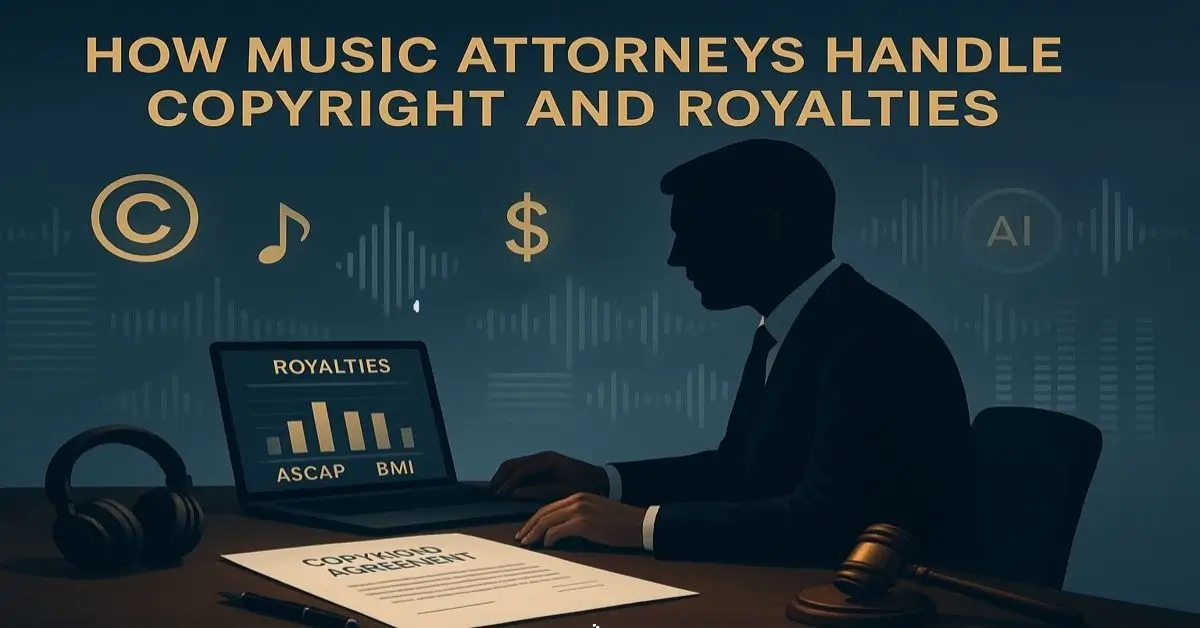
Copyright is the backbone of your income. A music industry attorney ensures your rights are registered, protected, and monetized.
They help with:
- Copyright registration for both sound recordings and compositions.
- Filing DMCA claims against unauthorized uploads.
- Setting up accounts with ASCAP, BMI, and SoundExchange for royalty collection.
- Conducting audits on distributors or labels to recover unpaid royalties.
Emerging issue (2025): AI-generated music and voice cloning are rewriting copyright law. Forward-thinking attorneys now include AI clauses in contracts, protecting your likeness, samples, and stems from unauthorized replication.
What’s the difference between a music attorney and an entertainment lawyer?
All music attorneys are entertainment lawyers, but not all entertainment lawyers specialize in music.
| Area | Music Attorney | Entertainment Lawyer |
| Focus | Music rights, royalties, record & publishing deals | Film, TV, theater, and digital media |
| Key Expertise | PROs, licensing, sampling, 360 deals | SAG-AFTRA rules, film contracts |
| Ideal Client | Artists, producers, songwriters | Actors, directors, screenwriters |
Think of it this way: a music attorney is a surgeon; an entertainment lawyer is a general practitioner.
How can I find a good music lawyer near me?
Finding a trustworthy music industry attorney takes more than a Google search. Look for real-world experience, not just credentials.
Here’s a simple checklist:
- Ask peers or managers for referrals.
- Check state bar directories and verified entertainment law associations.
- Review case experience: have they worked with artists like you?
- Always request a written fee estimate and engagement letter.
Independent platforms like LawTally or Avvo list qualified entertainment lawyers by state, with verified reviews and hourly rates.
What should I ask before hiring a music attorney?
The first consultation is your interview, treat it like hiring a tour manager or agent.
Ask these questions:
- “Have you handled deals like mine before?”
- “What’s your preferred communication style?”
- “What’s your billing method and response time?”
- “Can I see a sample engagement letter?”
Look for clarity, transparency, and mutual trust. If they rush or dodge questions, move on the right lawyer works with you, not over you.
Sources
- University of Pennsylvania Career Services: “What Is Entertainment Law?”
- Pepperdine Caruso Law Blog: “Entertainment Law Salary: What Can You Expect?”
- Texas Bar Blog: “SXSW CLE Wrap-up Part 3: Ethical pitfalls in entertainment law”
- Digital Commons @ DU: “Music Lawyers Taking the Rap: The Musicalization of Legal Ethics”
- Music Industry Weekly: “Resolved Legal Battles in Music: What We Learned and What’s Next for the Industry”
Author Bio
Evan D. Marks is a Music Business Legal Analyst with an experience of 12 years in advising independent artists and creative entrepreneurs. Evan Marks is a veteran music industry advisor helping independent musicians protect their work, secure fair deals, and navigate entertainment law since 2013.