
Key Intake
Q1: How often to rotate tires?
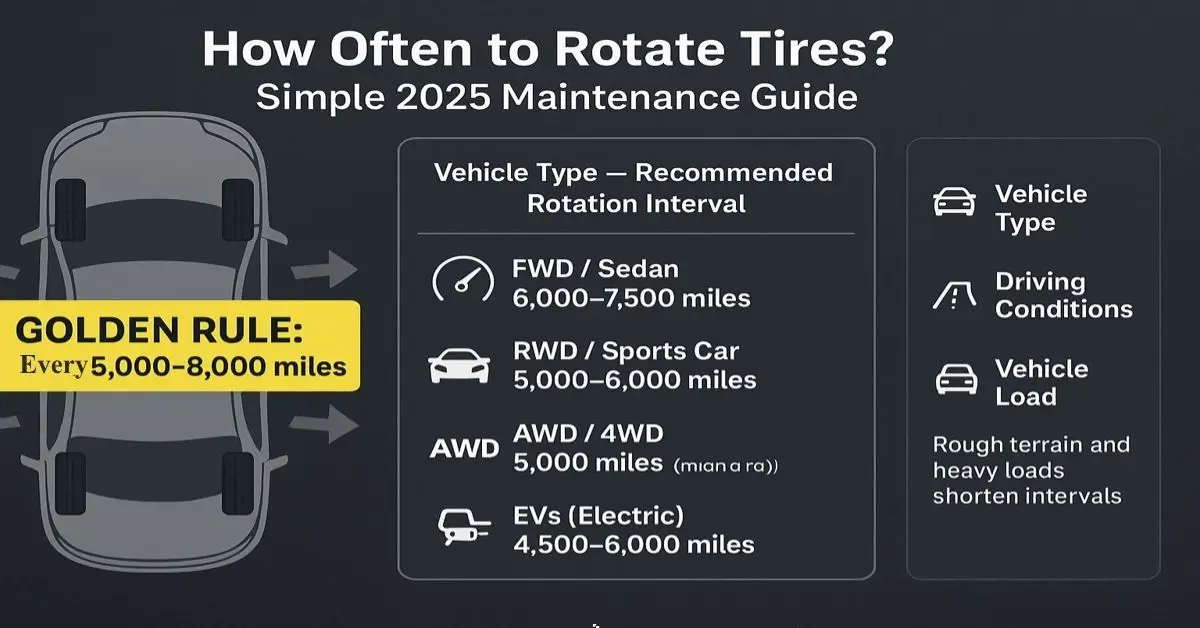
You should rotate your tires every 5,000-8,000 miles, or roughly every six months.
Q2: How long does a tire rotation take?
Typically 30-45 minutes for a full service, including inspection.
Q3: Should I align wheels during rotation?
Not necessarily, unless your car pulls to one side or tires wear unevenly.
Q4: Do new tires need rotation?
Yes, start early to establish even tread wear from the beginning.
Q5: Can you rotate tires with uneven wear?
Yes, but fix the underlying cause, likely misalignment or overinflation.
Q6: Is tire rotation covered under warranty?
Usually not, but following the rotation schedule is required to keep warranty valid.
Table of Contents
Introduction
Truth is, most drivers wait too long to figure out how often to rotate tires, and that mistake silently costs hundreds of dollars in premature wear and fuel loss each year. Tire experts from the Tire Industry Association and Bridgestone agree that rotating your tires every 5,000 to 8,000 miles can extend tread life by up to 25%. But that number isn’t one-size-fits-all, your vehicle type, driving style, and road conditions all play a role in determining how often to rotate tires for maximum safety and performance.
Unock More Insights
Quick Answer
You should rotate your tires every 5,000-8,000 miles, or roughly every six months. For electric vehicles or frequent highway or off-road driving, shorten the interval to about 5,000 miles. Consistent rotation evens out tread wear, improves handling, and prevents early tire replacement, saving up to $600-$1,200 over a tire’s lifespan.
Why Tire Rotation Matters?
Rotating your tires means changing their position to balance out wear. Front tires bear more stress from steering and braking. Without rotation, they’ll bald faster, leading to vibration, poor grip, and reduced braking efficiency. Think of rotation as insurance for your tires, it redistributes workload before damage begins. Understanding how often to rotate tires ensures that this process happens at the right intervals, keeping your tread even, performance smooth, and safety uncompromised.
Real-World Insight
On Reddit’s r/cars, one fleet owner shared that sticking to a 6,000-mile rotation schedule extended his trucks’ tire lifespan from 40,000 to nearly 60,000 miles. That’s a 50% gain for the same set of tires, just from consistent rotation.
If you are interested in knowing, How often to rotate tires then I highl;y recommend watching:
→”When should you rotate your tires?“
How Often Should You Rotate Tires?
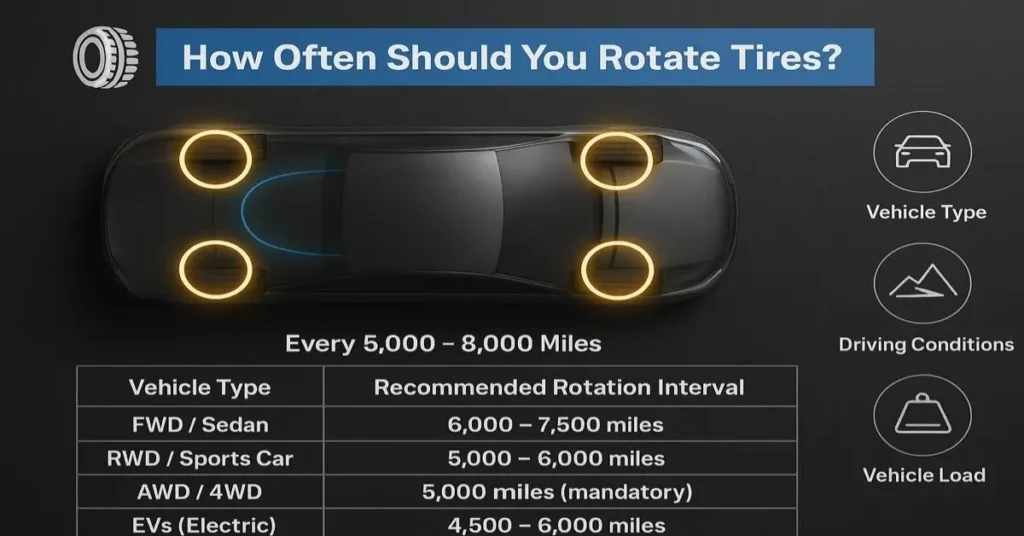
The golden rule is every 5,000-8,000 miles. That aligns neatly with every other oil change for most vehicles. But your exact schedule depends on three factors:
- Vehicle Type: FWD cars wear front tires faster; AWD vehicles require uniform tread to avoid drivetrain stress.
- Driving Conditions: Rough terrain, gravel, or city stop-and-go can demand 5,000-mile intervals.
- Vehicle Load: Heavier vehicles or frequent towing stress rear tires faster.
| Vehicle Type | Recommended Rotation Interval |
| FWD / Sedan | 6,000–7,500 miles |
| RWD / Sports Car | 5,000–6,000 miles |
| AWD / 4WD | 5,000 miles (mandatory) |
| EVs (Electric) | 4,500–6,000 miles |
What Happens If You Don’t Rotate Tires?
Skipping tire rotation leads to uneven tread wear, and once it starts, it can’t be reversed. You’ll notice pulling to one side, vibration in the steering wheel, and reduced traction, especially in wet conditions. Financially, expect to lose 25-40% of total tire life, translating to earlier replacement costs. That’s exactly why understanding how often to rotate tires for optimal performance and longevity becomes crucial, neglecting this simple maintenance routine directly impacts both safety and savings.
| Consequence | Result |
| Uneven wear | Shorter tire lifespan |
| Poor handling | Safety risk on wet roads |
| Drivetrain stress | Expensive AWD repairs |
| Increased rolling resistance | Lower fuel efficiency |
According to Consumer Reports, uneven tires can reduce fuel economy by up to 3%, costing an average driver nearly $100 annually in wasted fuel.
If you are one of those who are still concerned that if rotating tires is important or not then we highly recommend watching:
→”Do Tire Rotations Really Help & How Should They Be Done?! Let’s Talk About It…“
Does Tire Rotation Include Balancing or Alignment?
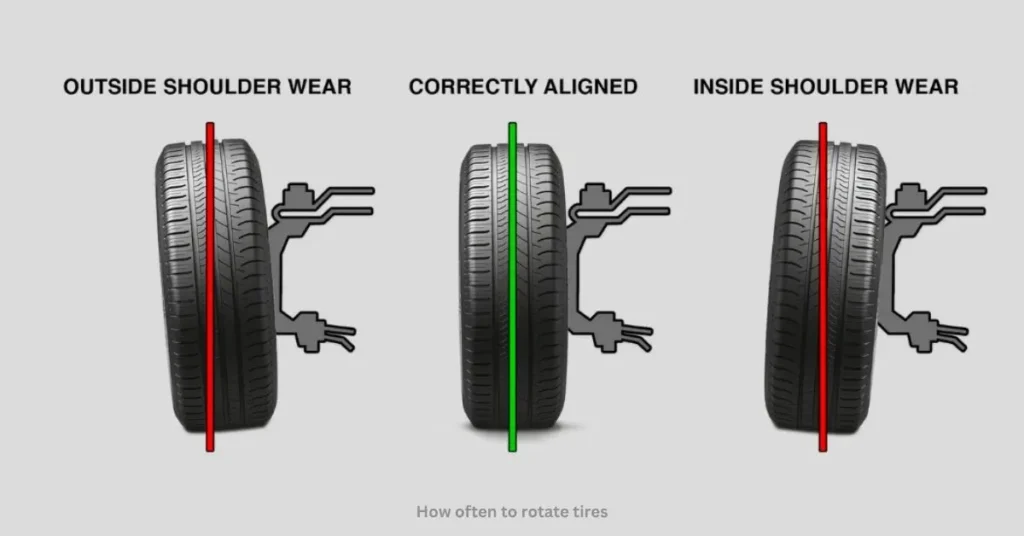
No, these are separate but complementary services.
- Rotation moves tires around to even out wear.
- Balancing corrects weight differences in the wheel-tire setup to eliminate vibration.
- Alignment adjusts suspension angles for proper tracking.
Truth is, most drivers skip balancing until vibration appears. But technicians recommend balancing at every rotation if you notice wobbling, especially after hitting potholes.
Cost: Is Tire Rotation Worth It?
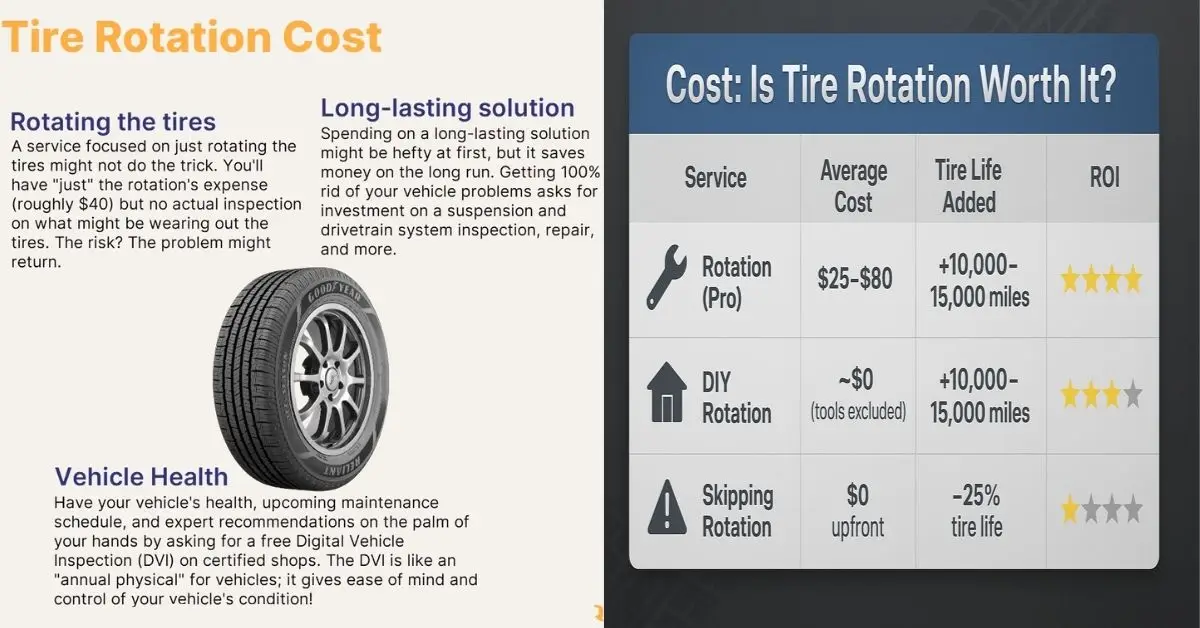
Absolutely. Professional tire rotation typically costs $25-$80, and many shops offer it free with tire purchase. Compare that to a $900+ replacement set, and the ROI becomes clear.
| Service | Average Cost | Tire Life Added | ROI |
| Rotation (Pro) | $25–$80 | +10,000–15,000 miles | ★★★★★ |
| DIY Rotation | ~$0 (tools excluded) | +10,000–15,000 miles | ★★★★★ |
| Skipping Rotation | $0 upfront | -25% tire life | ★☆☆☆☆ |
Can You Rotate Tires Yourself?
Yes, it’s safe and doable with the right tools and knowledge. You’ll need:
- Hydraulic jack + jack stands
- Lug wrench
- Torque wrench
- Tire rotation pattern diagram
DIY Rotation Steps (Simplified):
- Park on a flat surface, engage parking brake.
- Loosen lug nuts slightly.
- Jack up and support the vehicle.
- Move tires according to the correct pattern (see below).
- Hand-tighten, lower, and torque bolts in a star pattern.
- Check tire pressure afterward.
Which Tire Rotation Pattern Should You Use?
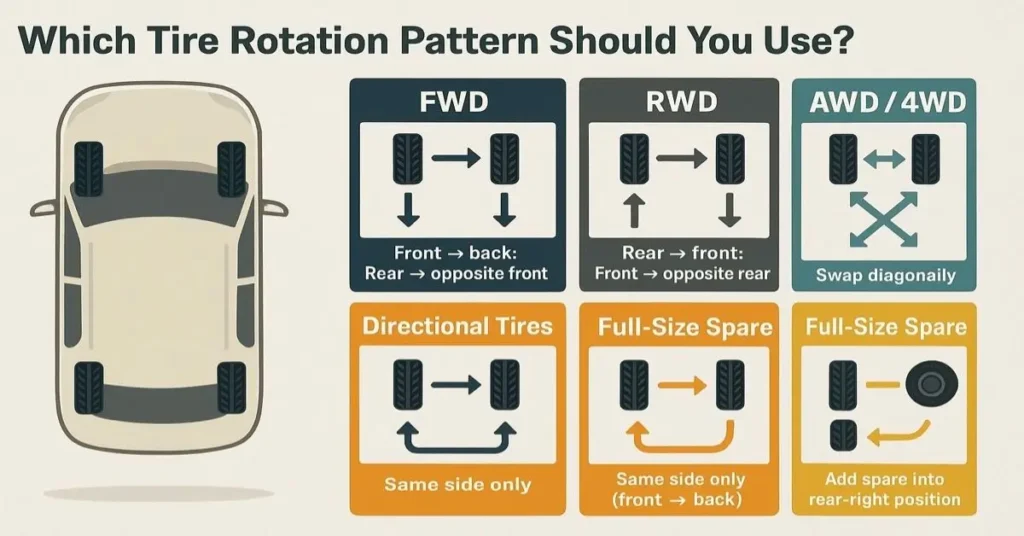
The right rotation pattern depends on your vehicle and tire type:
| Tire Type / Drivetrain | Rotation Pattern | Description |
| FWD | Forward Cross | Front → back, Rear → opposite front |
| RWD | Rearward Cross | Rear → front, Front → opposite rear |
| AWD / 4WD | X-Pattern | Swap diagonally |
| Directional Tires | Front-to-Back | Same side only |
| Full-Size Spare | Add spare into rear-right position |
Pro Tip: Directional tires can’t be swapped side to side. Keep them on the same side, front to back only.
EVs: A Special Case
Electric vehicles demand more frequent rotations.
Why? Instant torque and heavy battery packs create extra stress on the drive tires, wearing them out faster.
- Recommended: Every 4,500–6,000 miles
- Example: Tesla and Rivian owners on Quora report rear tires wearing out 30% faster without early rotations.
- Bonus Tip: Always check tire pressure monthly, EVs lose efficiency fast with even small PSI drops.
Condition-Based Adjustment: Not All Roads Are Equal
If you’re in a rural or off-road area and wondering how often to rotate tires, the answer is simply rotate more frequently, around every 5,000 miles or sooner. Gravel, mud, and uneven terrain grind down treads unevenly. Fleet drivers often rotate quarterly to prevent blowouts under heavy loads.
Checklist for Shorter Intervals:
- Drive on unpaved roads weekly
- Frequently carry or tow heavy loads
- Live in hot or mountainous regions
- Notice shoulder wear faster than center tread
If you said yes to two or more, shorten your rotation schedule by 1,000-2,000 miles.
Sources
- Tire Industry Association (TIA): Official tire service standards, rotation intervals, and maintenance training programs.
- U.S. Department of Energy (DOE): Fuel economy studies linked to tire maintenance and air pressure optimization.
- National Highway Traffic Safety Administration (NHTSA): Safety bulletins on tire age, rotation, and tread-depth compliance.
- SAE International (Society of Automotive Engineers): Peer-reviewed tire wear analysis and rotation methodology for drivetrain types.
- Automotive Service Excellence (ASE): Professional certification benchmarks for tire rotation and alignment practices.
- Michelin Tires: EV and all-wheel-drive rotation schedules with wear pattern data.
Final Takeaway
Rotating your tires isn’t just maintenance, it’s a performance strategy. Whether you drive a Tesla, truck, or city sedan, consistent rotation boosts tire life, fuel economy, and safety. Skip it, and you’ll literally burn money every mile.
Author Bio
Dylan Rakes is an Automotive Maintenance Specialist (with 15 years experience)
Expert in tire dynamics, fleet upkeep, and consumer vehicle performance optimization.